Part #1 of Supply Chain Series: Sourcing and supplier collaboration

By Ida Kuijken and Alexandra de Klerk, Fortino Capital
With this first edition of the Supply Chain Series, we go into the sourcing and supplier collaboration layer of the broader supply chain software market. The sourcing and supplier collaboration market is a €6.7Bn market globally, growing by 13%. It is closely interlinked with planning and visibility, and therefore grouped under the same domain in our market categorisation, preferring to keep a linear supply chain for simplicity purposes. For context on the overall market, we recommend reading our introduction.

The evolving role of sourcing and supplier collaboration
Supply chains overall are becoming more complex, and with this, sourcing and supplier collaboration requires a more complete, data-driven view. Historically, companies assessed suppliers mainly on unit cost. This is shifting towards a total cost of ownership (TCO) thinking, which takes into account e.g. operational performance, inventory buffers, CO₂ taxes, end-of-life disposal, and overall supplier resilience. The focus is moving towards a more holistic view on value creation.
Factors driving this change:

These drivers create opportunities for software founders to bring value to your customers by solving their pain points. AI, IoT, and blockchain are being applied to provide more timely insights, support risk management, automate sourcing, and streamline supplier collaboration.
On the contrary, companies sticking with fragmented legacy systems are exposed to rising costs, operational risk, and reputational harm. It is therefore key to be the partner that can help procurement teams make smarter, faster, and more strategic decisions.
Key challenges reshaping sourcing and collaboration
We see three key trends shaping sourcing and supplier collaboration:
1. Managing complexity and volatility
Procurement teams today face increasing uncertainty from macroeconomic shifts, trade disruptions, and climate-related risks. Traditional manual processes often fail to provide the visibility or agility needed to respond quickly, with up to 20% higher procurement and logistics costs as a result. Put differently, $1.5T USD revenue from Fortune 500 companies is estimated to be lost every year due to production downtimes, mainly caused by supply chain inefficiencies and disruptions.
This challenge creates opportunities for software founders to deliver value to their customers:
- Accelerate supplier onboarding → Enable faster supplier activation and diversification to adapt to shifting market conditions, improving resilience and increasing supplier diversity. Today, ~50% of companies still rely on word, excel or email for supplier onboarding with no central platform, making the process lengthy and inefficient (often >50 days).
- Enable seamless collaboration → Better tools for information-sharing and communication can simplify supply chains and strengthen relationships across the ecosystem. Whilst important for visibility, this is still ‘work in progress’. Whilst many recognise the benefits, there are difficulties to achieve streamlined systems, data, and processes.
- Leverage analytics for smarter decisions → Advanced analytics can detect vulnerabilities and anomalies, automate categorization, and support faster, more informed sourcing decisions. Recent advancements in ML and AI make it possible to develop better analytics capabilities.
Some companies that are navigating this complexity well include Ivalua, Procuros, Flockscore, Arkestro, Quyntess, SupplyOn and Sourcedogg.
2. Shrinking margins and budget constraints
Pressure on procurement is increasing with inflation, volatility, disruption and complexity leading to shrinking margins and budget constraints. Companies face increasing costs for raw materials, transportation, and labour, whilst increasing complexity leads to higher inefficiencies as mentioned above.
Opportunities for software founders:
- Smarter spend management → Consolidate spend data and leverage advanced analytics to identify savings, optimize supplier negotiations, and drive stronger financial outcomes.
- Workflow automation → Automate repetitive tasks and manual processes to reduce operating costs and improve efficiency across procurement and sourcing.
- Real-time visibility → Equip companies with live insights into supplier performance and market dynamics, enabling faster decision-making and helping protect margins.
We are impressed by what e.g. Akirolabs, KodiakHub, Omnea, Ignite, and Felix are building in this space.
3. Sustainability as a strategic requirement
ESG is no longer optional. Regulatory, investor, and customer pressures are forcing companies to track emissions, prevent environmental harm, and enforce fair labour practices. This has a clear impact on procurement: 57% of companies now include ESG criteria in RFPs/RFIs, and 85% have disqualified suppliers over ESG concerns. With this, ESG performance has become one of the key purchasing criteria. Even though it is (unfortunately) fair to say that the current political climate is shifting attention away from ESG, in the medium-term sustainability remains a core element in procurement.
Opportunities for software founders:
- ESG-driven procurement → Integrate ESG data directly into procurement workflows to help organisations compare and select low-emission suppliers, reduce resource waste, and comply with environmental regulations.
- Automated compliance checks → Embed real-time, automated compliance processes to ensure suppliers meet regulatory and contractual requirements without slowing operations.
- Trusted supplier networks → Create ‘trusted supplier’ statuses based on verified data, enabling faster decision-making and stronger supply chain resilience.
Some companies we track include Supplier.io, Verso, Vizibl and Archlet.
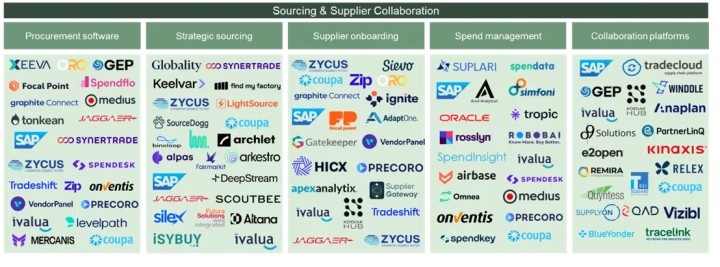
Non-exhaustive overview of the sourcing and supplier collaboration landscape
We subsegment the sourcing and supplier collaboration market in procurement software, strategic sourcing, supplier onboarding, spend management and collaboration platforms. The different subsegments are closely linked to supply chain planning.
Emerging technologies
Emerging technologies allow procurement to move beyond reactive, transactional tasks and make more strategic, data-driven decisions. These developments bring the most exciting areas to track.
Artificial Intelligence helps turn procurement data into practical insights. It can predict trends, assess supplier risk in real time, automate contract reviews, and monitor compliance and supplier performance. More advanced AI systems can even manage orders, allocate budgets, and handle reordering from suppliers, freeing procurement and finance teams to focus on strategic priorities. These capabilities are especially valuable in periods of budget pressure or tightening margins, where immediate, measurable results matter.
The Internet of Things adds another layer of visibility, tracking shipments, inventory, and equipment in real time. This allows procurement and operations teams to respond faster to disruptions and anticipate potential bottlenecks before they become problems.
Blockchain and smart contracts add a new level of transparency and trust to supplier relationships. When leveraging blockchain, every transaction is recorded in a tamper-proof ledger, making compliance easier to monitor and audits faster to complete. These tools can highlight inefficiencies, reduce operational waste, and flag potential risks before they escalate. By giving procurement teams real-time insights and control, blockchain and smart contracts help shift procurement from a back-office function to a more strategic role, improving collaboration, efficiency, and resilience across the supply chain.
The impact of AI
We don’t believe “AI will eat software”, but we do believe it will reshape and disrupt the industry, creating value for early adopters, and destroying value for laggers. 92% of companies are planning to increase their AI investments in the coming three years. We therefore spend a bit more time outlining our views on the impact and potential of AI.
Practical AI use cases
Let’s start relatively practical.
AI is transforming procurement by shifting it from manual, reactive processes to more strategic and data-driven decision-making. Modern tools combine financial stability data, geopolitical information, and historical supplier performance to generate real-time risk scores. In practical terms, it allows customers to track more variables, more real-time. This enables procurement teams to quickly identify high-risk suppliers and make more informed decisions.
Supplier selection and onboarding can therefore become faster and smarter. Instead of manually verifying credentials, financial health, and compliance, AI automates much of the process and flags potential issues early. Dashboards and audit trails make the process more transparent, while AI insights help optimise contract terms and reduce costly delays.
Some companies to track include Fairmarkit, Globality, Scoutbee and Altana.
Collaboration with suppliers is also evolving. AI can evaluate supplier capabilities, highlight performance gaps, recommend improvements, and automate contract management and payment triggers. Real-time communication keeps everyone aligned on production changes, while shared analytics improve forecasting and reduce stockouts. AI also supports joint demand planning and co-innovation, helping strengthen relationships and ensure quality, reliability, and timely delivery.
Collaboration is evolving with disruptors such as Graphite, Linkana, Orolabs or Hicx.
Spend management goes beyond basic spend tracking to deliver actionable insights. It identifies savings opportunities, automates invoicing, checks for compliance gaps, and provides real-time visibility into overall spend. Predictive models recommend suppliers and sourcing strategies, while advanced AI systems can simulate sourcing scenarios and even execute them autonomously.
Keep an eye out for developments at Sievo, ISPNext, or Medius.
Agentic AI
Even more exciting.
Most AI tools today are reactive: You prompt, they respond. But agentic AI is proactive, autonomous, and continuously learning. Agentic AI combines two key benefits: Enhanced data analysis and the ability to act on insights. AI helps procurement teams leverage large amounts of data, spot hidden patterns, and understand the bigger picture faster to then take action to strengthen supply chains.
This is not that much of a distant vision; agentic AI is already delivering tangible results today. Supply chain software providers are already using specialized AI agents to handle a wide range of tasks that consume significant time and manual effort, as outlined below.

Looking ahead, these point solutions will evolve into fully orchestrated systems. At the top, hierarchical agents will act as managers: A supervisory “orchestrator” agent sets strategic goals such as compliance, cycle time, and cost efficiency. Beneath it, specialized agents will handle distinct functions similar to the point solutions mentioned above, each executing its task while reporting outcomes upward.
Some companies to track in this space include Zycus, Arkestro, Keelvar, Resilinc and Mercanis.
Digital twins
Down the future path of what’s possible.
Over the next decade, ~80% of supply chain decisions could become autonomous, which in turn could help against margin pressure or budget constraints. Whilst this sounds exciting, getting there requires good quality and structured data. Moreover, high quality execution requires complete, accurate, and low latency signals. That means collecting and connecting data from all players (suppliers, distributors, logistics providers, trade partners, ..).
This will not happen by simply throwing AI on an existing database. It takes verticalized AI that understands your workflows, running on a data network that continuously collects, connects, normalizes, corrects, enriches, and validates data at scale, producing useable input in real time. It also requires strong safeguards to ensure the right processes are followed, and should (for now) include a human in the loop for review and approvals.
However, if you do get it right… The potential is huge, as this intelligence could ultimately power a live digital twin of the physical supply chain (sorry for the buzzwords but its practical use could be exciting). A dynamic model that instantly reflects changes. Preconnected business networks deliver standardized data in a single model, driving processes that execute, monitor, detect deviations, and correct themselves automatically. This enables the AI to evaluate network wide tradeoffs and trigger actions as they happen freeing human talent to focus on exceptions and strategic oversight. Over time, the combination of improved data quality and data gathering creates a flywheel effect, continuously improving the accuracy and responsiveness of the digital twin.
Practical advise for founders in procurement tech
Now back to reality.
As new technologies transform procurement it is easy to get carried away by futuristic ideas. But the most effective starting point is not innovation for its own sake, it is solving real, operationally painful problems. Below are four foundational principles for building meaningful procurement solutions with emergent technologies:

Why this matters
Modern platforms now go beyond basic procurement, embedding total cost of ownership and sustainability into workflows, enhancing collaboration across global supplier networks, and providing real-time visibility into supplier risk, performance, and compliance. They help reduce operational risk, improve efficiency, and maintain resilience, even under budget pressure.
For software founders, this represents a double-digit growth opportunity. Enterprises increasingly seek solutions that transform procurement from a reactive, transactional function into a strategic driver of value, enabling smarter sourcing, faster supplier onboarding, and more informed decision-making.
Further reading
[1]: Statista (2025). Supply chain management outlook.
[2]: Emergen Research (2023). Demand for real-time spend analysis.
[3]: Gartner (2024). Sourcing and procurement report.
[3]: ZIP company resources (2025). Company resources.
[5]: The Business Research Company (2025). Global market report.
[6]: Ardent Partners (2025). Procurement 2025: Big trends and predictions.