Part #2 of the Supply Chain Series: Planning & Visibility

By Ida Kuijken and Alexandra de Klerk, Fortino Capital
In this second edition of the Supply Chain Series, we focus on planning and visibility.
Planning and visibility sit at the core of any supply chain. This layer determines how much to buy, where to hold stock, and how to respond when macro shocks or day-to-day disruptions force a change of plans.
That matters more than ever now. Supply chains are dealing with more volatility, more data, and more pressure to react quickly, yet many companies still rely on planning systems built for stable environments. These static systems work forperiodic planning cycles, but they struggle when the conditions change halfway through. This is also an area where we see a lot of AI innovation, with a clear ROI and a need for richer, real-time data.
If you want the bigger picture first, we recommend reading our introduction, followed by Part 1: sourcing and supplier collaboration.
The market
We estimate the planning and visibility segment at ~€8.8Bn today, sitting next to the ~€6.7Bn sourcing and supplier collaboration segment we covered in Part 1. The category keeps growing double-digit, driven by manufacturers, retailers, and logistics players that need tighter control over inventory, service levels, and risk.
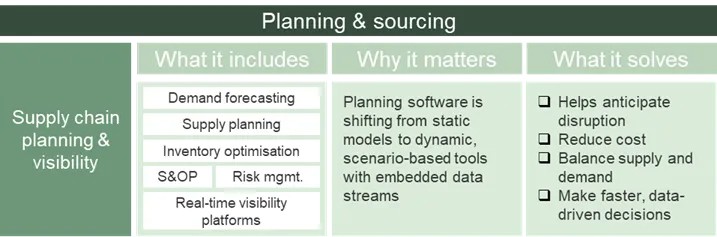
We divide planning and visibility into five interconnected areas:
- Demand forecasting: Predicts customer demand across products, channels, and geographies.
- Supply Planning: Translates forecasts into actionable orders, production schedules, and replenishment decisions across the network.
- Inventory optimization: Determines the right stock levels across the network.
- S&OP / IBP (Sales & Operations Planning / Integrated Business Planning): Aligns commercial, operational, and financial targets.
- Real-time supply chain visibility: Tracks goods and flows end-to-end.
These areas reinforce each other. Better forecasts improve inventory decisions, and better visibility improves the next forecast, so the biggest value starts to exist when these feedback loops work inside one system.
Key trends driving growth of the planning and visibility layer
Trend 1. Demand planning and forecasting is moving from static to dynamic
Older systems rely on fixed planning cycles. Teams load historical data, run a plan, and then spend the rest of the week reacting/firefighting to what the plan missed. Newer platforms run on shared data models, update continuously, and let planners test scenarios fast.
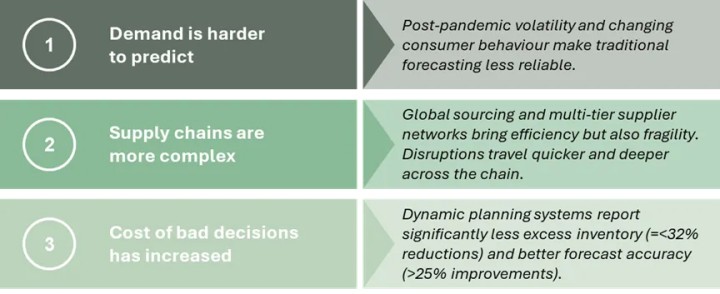
Several macro shifts are making planning harder and are increasing the need for better software:
Opportunities for software founders:
- AI-powered demand sensing → Uses live signals from POS systems, weather data, social media, and market indicators to update forecasts in near real-time.
- Probabilistic planning → Model a range of different demand outcomes to make smarter and risk-aware inventory and replenishment decisions.
- New product forecasting → Attribute-driven logic for new SKUs without manual product matching.
Kinaxis and o9 Solutions were early leaders in the shift to dynamic planning. Anaplan and OMP link supply chain, commercial, and financial planning in one model. Newer players such as Pigment attempt to make connected planning easier to use across the entire business instead of in specialized teams only. RELEX built a strong product around retail demand signals, while Flowlity, Lokad, and ToolsGroup pushed further into probabilistic forecasting and autonomous replenishment.
Trend 2. S&OP / IBP: Connecting sales, operations and finance through one system
The subsequent step after reacting to demand is shaping it. This requires a link between commercial levers such as pricing and promotions and the planning process to be able to influence demand. As a result, demand planning is moving closer to S&OP and IBP.
In many businesses S&OP still depends on meetings, spreadsheets, and slow trade-off discussions between sales, operations, and finance. Better software can fix part of that by giving all three one shared model for planning and scenario testing.
Opportunities for software founders:
- Connected planning across functions → Combine commercial, operational, and finance planning with a shared model.
- Faster scenario modelling → Helps planners simulate multiple what-if cases.
- Collaborative workflows → Replace email chains and spreadsheets with more structured review processes.
Slimstock, Colibri, Imperia, and Netstock are all building structured planning products for the mid-market. They each have a slightly different angle, focusing on usability, faster deployment or building custom planning logic with natural language.
Trend 3. Inventory optimization offers strong ROI
Inventory optimization gets less attention than other parts of planning, but it often delivers the highest return. Excess stock ties up cash and poor stock placement drives missed service levels and increases waste, which both directly hurt financial performance. Modern inventory tools can reduce excess stock up to 32%, and improve availability at the same time, especially across multi-echelon networks.
Opportunities for software founders:
- Multi-echelon optimization → Set safety stock and replenishment parameters dynamically across the distribution network.
- Autonomous replenishment → Move towards automated purchase order generation, with human review only by exception.
- Shelf-life and waste management → For perishable categories (food, pharma, etc.) integrate freshness constraints into restock logic to reduce waste.
Many companies still manage replenishment in Excel or in rigid ERP logic. Rewize and Optiply are good examples of a newer generation moving SMEs towards more automated workflows.
In inventory optimization data is usually the biggest constraint. Good inventory decisions need clean ERP data, reliable demand signals, and a system that updates (often enough). So you need to fix your data first, before a more modern software solution can deliver the full benefit.
Trend 4. Supply chain visibility is becoming more strategic
The visibility market now stands at ~$3Bn, growing >13% CAGR. Customer expectations are higher whilst at the same time service failures are more visible and supply chain shocks hit faster. This leads to companies requiring earlier warning signals and better control.
Opportunities for software founders:
- Predictive ETAs and exception management → Reduce manual intervention with delay predictions, carrier alerts and automated exceptions handling.
- Multi-tier supplier visibility → Visibility into the broader network (not only within tier-1 suppliers).
- Visibility to action → Integrate detections directly into planning.
Transport visibility specialists like project44, Shippeo and Transporeon focus on shipment tracking and predictive ETAs. Broader platforms connect demand, supply, and logistics across a wider network. Specialist players like Tive, Pelico, and Wakeo focus on narrower use cases such as sensitive shipments, factory orchestration, or multimodal flows.
The hardest problems usually sit deeper in the supply chain, where supplier risk, lead-time problems, and compliance issues often start. EU DD rules and CSRD reporting are increasing the need for sub-tier visibility, giving tailwinds to solutions that are able to provide this.
Trend 5: The impact of AI
In procurement (Part 1 of our series), we explained how AI helps decide whom to buy from. In planning, it helps decide how much to buy, when to move, and how to react when assumptions fail. That makes planning one of the most valuable use cases for AI in the supply chain.
The near-term use cases include improved forecasting, faster scenario planning and earlier exception detection. For inventory optimization AI can support replenishment decisions, and is starting to automate parts of this process.
The next step is agentic-driven planning. A planning agent can test scenarios, tune parameters, flag risks, and adjust stock logic faster than a (human) team. nShift, o9, and Kinaxis have all launched products in this direction. ketteQ focuses on autonomous scenario planning. AIMMS brings strong optimization and trade-off modelling to network design and planning decisions. The market is still early, but the general direction is that planning tools are shifting from systems of record to systems of action.
This shift creates new challenges too. More automation means more dependence on data quality, system security, and model transparency, and black-box recommendations are a real problem in planning. Teams need to know why a system made a recommendation before they can trust it in their daily operations.
Trend 6: Planning and visibility are converging
The most important trend across the segment is convergence.
Most companies still run planning and visibility as separate processes. One team builds the plan and another tracks execution; creating a delay caused by more manual work, and with more risk of sub-optimal decision making.
When planning and visibility converge, visibility data flows directly into the planning engine, so the system detects deviations in real time and updates the plan accordingly. A platform with data from one customer can improve local decisions, but a platform with data across thousands of shippers, carriers, suppliers, and warehouses can spot patterns far earlier, and over time that creates a real structural advantage.
We also discussed digital twins as the long-term destination for procurement intelligence, a live model of the supplier network that detects deviations and corrects itself automatically. In planning and visibility, that vision is already closer to reality, because the data is denser and the feedback loops are faster. As planning and visibility converge, this path towards a digital twin is becoming more tangible.
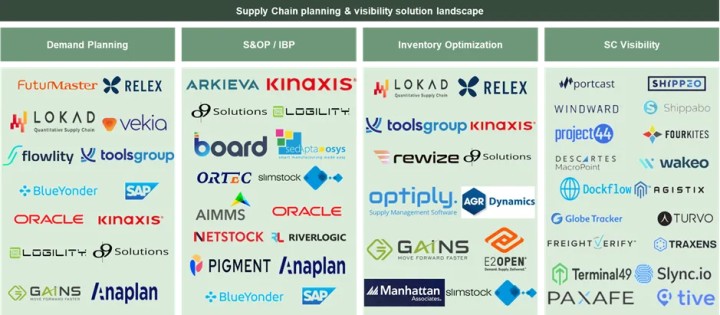
A non-exhaustive overview of the landscape
Why this matters
Only 6% of businesses report full supply chain visibility today, and many still rely on tools built for a different era. Better planning reduces stockouts, excess inventory, delays, and wasted labor, and these systems sit deep in daily workflows, which makes them sticky once adopted.
The gap between the complexity companies face and the software they use to manage it is still large. We think this gap will close over the next decade, and we are curious to see who the winners are that will close this gap.
If you are building in this space, investing in it, or simply interested in contributing ideas, we would love to connect.
Further reading
[1]: Statista (2025). Supply chain management software market outlook.
[2]: Gartner (2025). Magic Quadrant for Supply Chain Planning Solutions.
[3]: Gartner (2025). Cool Vendors in Supply Chain Management.
[4]: ISG Software Research (2025). Buyers Guide for Supply Chain Planning.
[5]: Global Market Insights (2025). Supply chain visibility software market report.
[6]: StatsMarketResearch (2025). S&OP software market size and forecast.
[7]: ARC Advisory Group (2025). Supply Chain Planning market research.