Part #3 of the Supply Chain Series: Execution & Product Management
Written by Ida Kuijken and Alexandra de Klerk, Fortino Capital
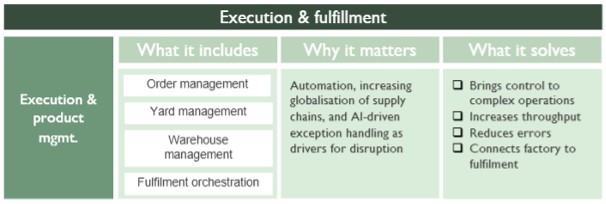
In this third edition of the Supply Chain Series, we move on to execution and product management, the first of four sub-segments within execution and fulfilment.
Parts 1 and 2 focused on software that improves decisions and calculations. This segment is different: Software must coordinate physical operations in real time, from robots and conveyors to pickers, dock doors and trucks.
Even when vendors do not build the hardware, their software sits close to it. That creates deeper integrations, richer data and higher switching costs. In an AI-driven market, software embedded in physical operations is also harder to displace than software that exists purely in the cloud.
If you want the bigger picture first, we recommend reading our introduction, followed by Part 1: sourcing and supplier collaboration and Part 2: planning and visibility.
The market
The execution & product management sub-segment is estimated to represent a €9Bn global software market in 2025, growing at low-to-mid teen annual growth rates.
Warehouse Management Systems (WMS) forms the largest category, representing a market of ~€4Bn today. WMS acts as the system of record for warehouse operations, managing workflows from receiving to dispatch. Driven by automation, cloud migration and rising fulfilment complexity, the market is expected to more than double by the end of the decade.
Yard Management Systems (YMS) represent a ~€1.5-2Bn market. Positioned between transportation and warehouse operations, YMS coordinates truck appointments, trailer movements, driver check-in and dock scheduling. Yard operations remain highly manual across much of the industry, creating a significant opportunity for digitisation.
Order Management Systems (OMS) account for ~€3Bn of the market. OMS determines where and how customer orders are fulfilled. Omnichannel commerce, distributed inventory and faster delivery expectations is driving double-digit market expansion.
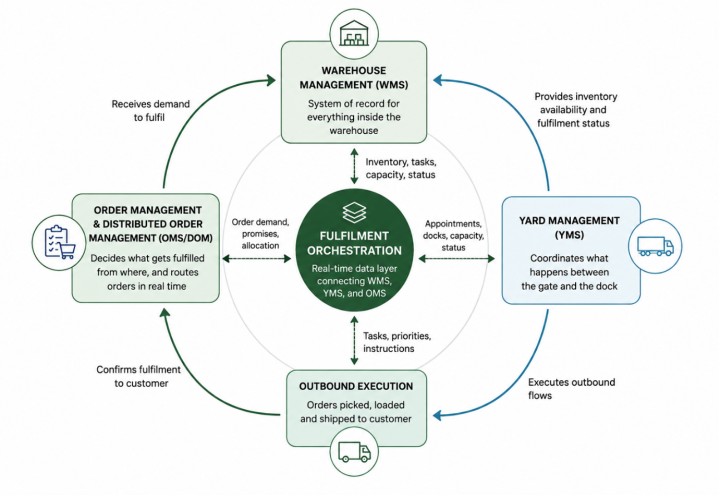
Fulfilment orchestration Is an emerging ~€1–1.5Bn software layer which connects WMS, OMS and YMS. It enables real-time decision making across inventory, capacity and fulfilment workflows.
The categories increasingly overlap. Better warehouse execution improves the inventory data used by the OMS, while efficient yard operations prevent dock delays from affecting delivery promises. As in Part 2, the greatest value emerges when these feedback loops connect, as visualized below.
Trend 1. Warehouse management is becoming an execution intelligence layer
End-consumer expectations are driving the shift: 89% of Europeans aged 18–34 now expect next-day delivery, while 43% have abandoned purchases due to slow delivery options. Meanwhile, order volumes have doubled since 2019 and Europe faces more than 270k unfilled transport and logistics roles. Together, these pressures make warehouse technology an operational necessity rather than simply a way to reduce labour costs, accelerating the move away from legacy WMS platforms.
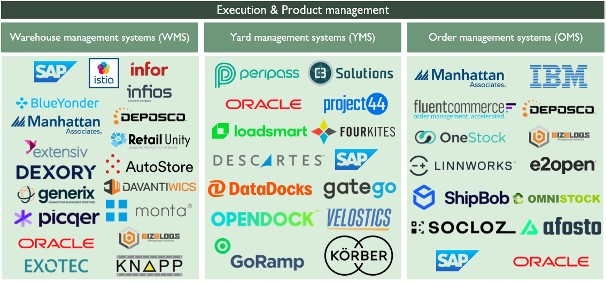
The enterprise WMS market remains stable, led by Manhattan Associates, Blue Yonder, SAP EWM, Infor, and Infios. But implementations often take 12–18 months and reach seven-figure costs, leaving much of the mid-market underserved.
That gap is being filled by faster, lower-cost platforms. In the Netherlands, MontaWMS serves 1,500+ e-commerce shops, while Diract IT, Picqer, Istia and DavantiWICS offer more flexible solutions shaped around mid-market needs. Bizbloqs and Retail Unity target smaller operators with integrated WMS and OMS products.
AI is strengthening the advantage of cloud-native platforms. Dynamic slotting adapts warehouse layouts to live demand, predictive maintenance reduces equipment downtime, and Dexory’s autonomous robots can scan >10k warehouse locations per hour to provide real-time inventory data.
Trend 2. Automation is moving from tier-one luxury to mid-market necessity
Warehouse automation was long limited to large retailers with the volumes and CapEx budgets to justify it. That is changing. Labour shortages have made automation a question of operational continuity, while robotics-as-a-service has shifted high upfront costs into more affordable subscriptions.
The market reflects this shift. Global warehouse automation is expected to grow from $30Bn today to $66Bn by 2031. Europe is a $7Bn market, growing at 19% toward $27Bn by 2033. Gartner estimates that by 2030, half of new warehouses in developed markets will be designed around robotics, while more than 80% of warehouses globally remain non-automated today.
The European robotics players worth knowing are Exotec (their Skypod deployed across Decathlon's European network delivers 4x productivity gains), AutoStore, (cubic storage AS/RS, moved toward a robotics-as-a-service model in 2025 and signed a $200M framework agreement for 50 sites under subscription), and KNAPP, which manages fleets of multi-agent AI systems. Interestingly, IKEA acquired Locus Robotics' AI routing technology in 2025, signalling that retailers are also moving into the robotics market themselves.
Unlike other areas in this series, the software is closely tied to the physical infrastructure it manages. Replacing a WMS often requires changes to the warehouse floor, making integration depth a real moat and increasing defensibility against both software competitors and AI disruption.
Trend 3. The yard: supply chain's most expensive blind spot
The yard remains a major blind spot between the TMS and WMS. Driver check-in, trailer positioning and dock assignment are still often managed through radios, whiteboards and spreadsheets, with ~90% of yards globally not yet digitised.
The cost is significant. Integrated visibility solutions saved the trucking sector over $1.2Bn in detention costs in 2024 alone. Automated dock scheduling pilots cut truck waiting times by 40% and lifted throughput by roughly 25% during peak weeks. In most cases, congestion is less a space problem than an information problem. As Greg Braun, co-founder of C3 Solutions, put it in a recent FreightWaves piece: the yard is where transportation and warehousing either synchronise or collide.
SAP acquired a niche yard management company for $85M in August 2025. Blue Yonder saw a 35% jump in yard software bookings in Q2 2025. Manhattan partnered with a cloud provider in June 2025 to offer yard modules for mid-market operators. Established players include C3 Solutions, Loadsmart (launched an AI and computer vision-powered YMS in February 2025), and enterprise modules from Descartes and the large WMS vendors.
A European name worth knowing is Peripass (Ghent), founded in 2016. Core proposition: automated truck dispatching, multilingual driver self-registration, real-time yard visibility, digital twin of the site. Reduces driver waiting times by up to 70%.
AI is also entering the yard. Computer vision can automate truck and trailer check-in, while predictive scheduling optimises dock sequences before arrival. Over time, this points toward increasingly autonomous yard operations with fewer manual decisions.
Trend 4. Order management becomes the real-time nerve centre of fulfilment
Composability is changing the OMS market. Rather than replacing their WMS or ERP, operators can add API-first platforms that connect existing systems and improve the flow of data between them. This is creating opportunities for newer vendors at the expense of legacy suites.
Distributed order management goes a step further by routing each order in real time across warehouses, stores, 3PLs and in-transit inventory. It balances availability, cost, proximity and delivery speed, where static routing rules increasingly fall short.
Forrester names Fluent Commerce, Manhattan Associates, and IBM Sterling as OMS leaders. More relevant mid-market challengers include OneStock, which enables ship-from-store, Deposco with its integrated WMS and OMS, and Linnworks for marketplace-heavy sellers.
AI is mainly improving order promising through anomaly detection, predictive routing and delivery commitments based on live inventory and carrier capacity. OneStock reports a 12% conversion uplift from dynamic delivery promises at checkout.
Why this matters
Execution is where software meets physical operations, and the gap between large operators and the European mid-market remains wide. Many mid-sized distribution centres still rely on legacy, batch-based WMS platforms, while ~90% of yards are managed manually. Europe has the expertise, but lower investment levels than the US continue to slow adoption.
What connects WMS, YMS, OMS, and fulfilment orchestration is the same argument we have made across this series: the value is not in any single system, it is in the data flows between them. The challenge is that each measures performance differently, from pick accuracy and fulfilment rates to working capital and margin. Creating a shared data and metrics layer is therefore critical to breaking down operational silos. That removal of the silo walls is one of the deepest challenges we see across the entire supply chain industry.
As with planning and visibility, these systems are converging into a continuous feedback loop. But because they directly control physical operations, delays between systems have an immediate cost. The strongest platforms are those that integrate the physical and digital layers and can be deployed in weeks rather than months.
If you are building in this space, investing in it, or simply interested in contributing ideas, we would love to connect.
Further reading...
[1]: MarketsandMarkets (2025). Warehouse Management System Market, $4.57Bn to $10.04Bn, 17.1% CAGR.
[2]: Gartner (2025). Magic Quadrant for Warehouse Management Systems.
[3]: Gartner (2025). Market Guide for Yard Management Systems.
[4]: Forrester (2025). The Forrester Wave: Order Management Systems, Q1 2025.
[5]: Nucleus Research (2026). OMS Technology Value Matrix, April 2026.
[6]: MarketDataForecast (2025). Europe Warehouse Automation Market, $7Bn to $27.4Bn by 2033, 18.56% CAGR.